
Embark on a journey to discover the intricacies of selecting the perfect income fund with this detailed guide. Exploring various factors and considerations, this article aims to equip investors with the knowledge needed to make informed decisions.
From understanding income funds to evaluating performance and exploring their role as an inflation hedge, this guide covers it all in a concise yet informative manner.
Understanding Income Funds
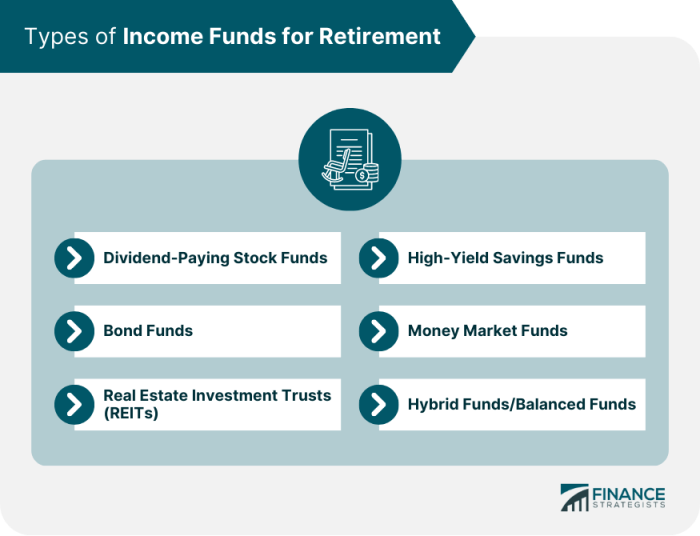
Income funds are a type of mutual fund that focuses on generating regular income for investors through various sources such as dividends, interest payments, and other distributions. These funds are popular among investors seeking a steady stream of income while also potentially benefiting from capital appreciation.
Types of Investments in Income Funds
Income funds typically include a mix of fixed-income securities such as bonds, treasury bills, and certificates of deposit (CDs). These investments provide a predictable income stream and are considered less risky compared to equity investments. Additionally, some income funds may also include dividend-paying stocks and real estate investment trusts (REITs) to enhance the fund’s income potential.
Comparison with Other Mutual Funds
Unlike growth funds that focus on capital appreciation, income funds prioritize generating income for investors. While growth funds may invest in high-growth companies with the potential for significant returns, income funds tend to have a more conservative investment approach, emphasizing stability and consistent payouts. Additionally, income funds are distinct from balanced funds, which aim to achieve a balance between income generation and capital growth by investing in a mix of stocks, bonds, and other securities.
Factors to Consider When Choosing an Income Fund
When selecting an income fund, it is crucial to take into account various factors that can impact the performance and suitability of the investment. Here are some key considerations to keep in mind:
Risk Factors Associated with Income Funds
Income funds, like any other investment, come with inherent risks that investors should be aware of. Some common risk factors associated with income funds include:
- Interest rate risk: Fluctuations in interest rates can impact the value of income funds.
- Credit risk: The risk of default by the issuers of the bonds held in the fund.
- Market risk: Changes in market conditions can affect the performance of income funds.
The Importance of Diversification in Income Fund Selection
Diversification is key when choosing an income fund as it helps spread risk across different asset classes and securities. By investing in a diversified income fund, investors can reduce the impact of any single investment underperforming or facing financial difficulties.
Impact of Investment Goals and Time Horizon
Investors should align their investment goals and time horizon with the choice of income fund. For example, if an investor has a short-term investment goal, they may opt for a more conservative income fund with lower volatility. On the other hand, investors with a long-term horizon may be willing to take on more risk for the potential of higher returns.
Evaluating Performance and Returns
When choosing an income fund, it is crucial to evaluate its performance and returns to ensure that it aligns with your investment goals and risk tolerance. Analyzing historical performance, interpreting yield and total return metrics, and considering expense ratios are key factors in making an informed decision.
Analyzing Historical Performance
One way to evaluate the performance of an income fund is by analyzing its historical performance. Look at how the fund has performed over different time periods, such as one year, three years, five years, and since inception. This can give you an idea of the fund’s consistency and volatility in generating returns.
Interpreting Yield and Total Return Metrics
Yield and total return metrics are essential indicators of an income fund’s performance. The yield represents the income generated by the fund, usually expressed as a percentage of the fund’s net asset value. Total return, on the other hand, includes both income generated and capital appreciation or depreciation. It is important to consider both metrics to get a comprehensive view of the fund’s performance.
Significance of Expense Ratios
Expense ratios play a significant role in evaluating income funds. These ratios represent the percentage of a fund’s assets that are used to cover operating expenses. Lower expense ratios can translate to higher returns for investors, as less of the fund’s income is being used to cover expenses. Therefore, it is important to compare expense ratios when choosing between different income funds.
Income Funds vs. Index Funds
When it comes to choosing between income funds and index funds, it’s essential to understand the key differences in their investment strategies and objectives to make an informed decision that aligns with your financial goals.
Differentiation
Income funds are investment vehicles that primarily focus on generating regular income for investors through dividends, interest payments, or other sources of income. On the other hand, index funds aim to replicate the performance of a specific market index by holding a diversified portfolio of securities that mirror the index’s composition.
Comparison of Investment Strategies
Income funds typically invest in a variety of income-producing assets such as bonds, preferred stocks, and dividend-paying equities to generate a steady stream of income for investors. In contrast, index funds passively track the performance of a market index by holding a proportional representation of the securities included in the index.
Pros and Cons
- Pros of Income Funds:
- Provide a consistent income stream for investors.
- Offer potential for capital appreciation along with income generation.
- Managed actively to adapt to changing market conditions.
- Cons of Income Funds:
- May have higher fees compared to index funds.
- Performance can be impacted by interest rate changes and credit risks.
- Not as diversified as index funds, which can increase risk.
- Pros of Index Funds:
- Low expense ratios due to passive management.
- Provide broad market exposure and diversification.
- Historically outperform actively managed funds over the long term.
- Cons of Index Funds:
- Do not offer the potential for significant income generation.
- Cannot outperform the market index they track.
- May not be suitable for income-focused investors.
Income Funds as Inflation Hedge
Income funds can serve as a hedge against inflation due to their ability to generate a consistent stream of income through dividends, interest payments, and other distributions. Inflation erodes the purchasing power of money over time, but income funds can help investors maintain their real returns by providing a steady income that can keep pace with rising prices.
Impact of Inflation on Income Fund Returns
Inflation can have a significant impact on income fund returns. As prices rise, the value of a fixed income payment decreases in real terms. However, income funds typically invest in a diversified portfolio of income-generating assets, such as bonds, dividend-paying stocks, and real estate investment trusts (REITs). These investments have the potential to increase their payouts over time, helping to offset the effects of inflation on the overall return of the fund.
- Income funds that focus on dividend-paying stocks of companies with strong track records of increasing dividends can be a good hedge against inflation. These companies have the ability to raise their dividend payouts in line with or above the rate of inflation, providing investors with a growing income stream.
- Real estate income funds, such as those investing in commercial properties or rental housing, can also be effective inflation hedges. Rental income from properties tends to increase over time, helping to protect investors against the impact of rising prices.
- Government bond funds, particularly those that invest in Treasury Inflation-Protected Securities (TIPS), are specifically designed to protect against inflation. TIPS adjust their principal value in response to changes in the Consumer Price Index (CPI), ensuring that investors receive a real return that keeps pace with inflation.
Considering Insurance Premiums and Income Funds
Insurance premiums and income funds are two key components in a diversified investment portfolio. Income funds can play a complementary role to insurance products by providing a steady stream of income, which can help offset the costs of insurance premiums and provide additional financial stability.
Balancing Insurance Premiums with Income Fund Investments
- It is important to strike a balance between paying insurance premiums and investing in income funds for long-term financial planning.
- Consider your insurance needs and the premiums you are paying to ensure adequate coverage for protection.
- Allocate a portion of your investment portfolio to income funds to generate regular income that can be used to cover insurance costs.
- Review your insurance policies regularly to ensure they align with your financial goals and adjust your income fund investments accordingly.
In conclusion, choosing the right income fund is a crucial decision for investors seeking to optimize their returns. By considering the factors discussed in this guide, investors can navigate the complex landscape of income funds with confidence and clarity.
Commonly Asked Questions
What are income funds?
Income funds are investment vehicles that focus on generating regular income through various assets like bonds, dividend-paying stocks, and other fixed-income securities.
How important is diversification when choosing an income fund?
Diversification is crucial as it helps spread risk across different investments, reducing the impact of market fluctuations on the overall portfolio.
What role do investment goals play in selecting an income fund?
Investment goals determine the risk tolerance and time horizon, influencing the choice of income fund that aligns with an investor’s objectives.
Can income funds act as an inflation hedge?
Yes, income funds can serve as a hedge against inflation by providing returns that outpace the rate of inflation over time.
How do expense ratios impact the evaluation of income funds?
Expense ratios represent the costs associated with managing the fund and can significantly impact the overall returns for investors.


