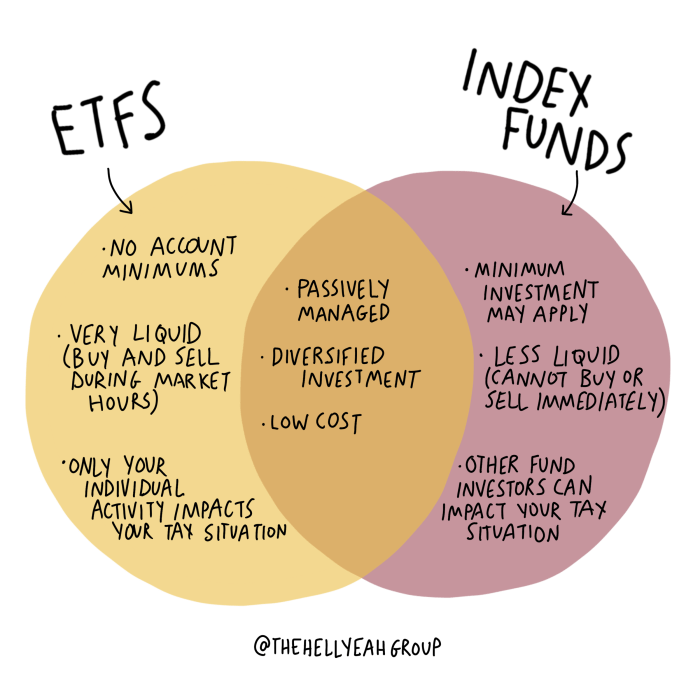
Exploring the differences between ETFs and index funds, this introduction sets the stage for an insightful discussion on the advantages, disadvantages, and tax implications of each investment option.
Readers will gain a clear understanding of how these two popular choices stack up against each other in the world of investing.
ETFs vs Index Funds
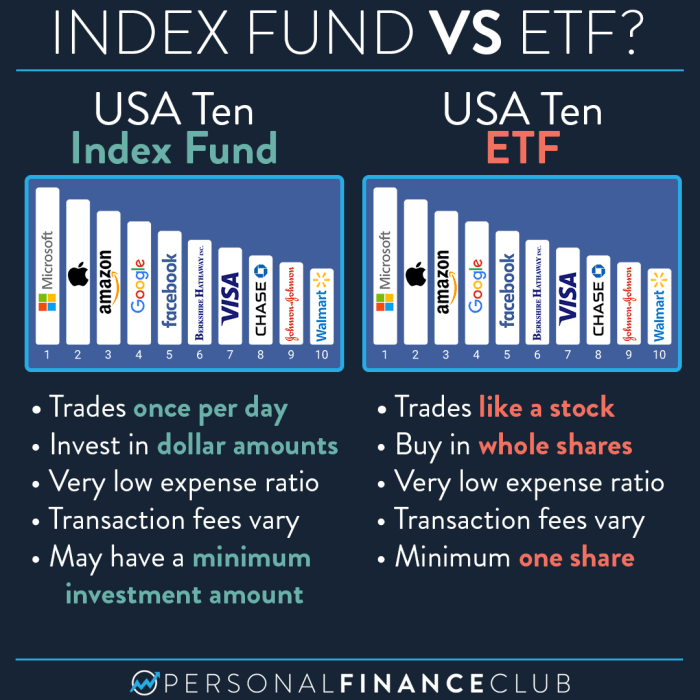
When it comes to investment options, ETFs and index funds are two popular choices among investors. While they may seem similar, there are key differences that set them apart.
Difference between ETFs and Index Funds
Exchange-Traded Funds (ETFs) are similar to mutual funds but trade on exchanges like stocks. They can be bought and sold throughout the trading day at market prices. On the other hand, index funds are mutual funds that aim to mirror the performance of a specific market index, such as the S&P 500.
Examples of ETFs and Index Funds
- Examples of ETFs: SPDR S&P 500 ETF Trust (SPY), Vanguard Total Stock Market ETF (VTI)
- Examples of Index Funds: Fidelity 500 Index Fund (FXAIX), Vanguard Total Stock Market Index Fund (VTSAX)
Advantages and Disadvantages of Investing in ETFs compared to Index Funds
ETFs offer intraday trading flexibility and may have lower expense ratios. However, they may also involve brokerage commissions and bid-ask spreads. Index funds, on the other hand, are simpler to understand and typically have lower expense ratios, but they cannot be traded throughout the day like ETFs.
Compare the Tax Implications of ETFs and Index Funds
ETFs are generally more tax-efficient than index funds due to their unique structure that allows for in-kind redemptions. This means investors can avoid capital gains taxes until they sell their shares. Index funds, on the other hand, may distribute capital gains to investors when the fund rebalances its holdings, potentially triggering tax liabilities for shareholders.
Income Funds
Income funds are a type of mutual fund or ETF that primarily focuses on generating regular income for investors through dividends, interest payments, or other distributions. These funds are popular among investors seeking a steady stream of income while also benefiting from potential capital appreciation.
Types of Assets in Income Funds
Income funds typically hold assets such as bonds, preferred stocks, dividend-paying stocks, real estate investment trusts (REITs), and other fixed-income securities. These assets are selected for their ability to generate consistent income for the fund.
- Bonds: Income funds often invest in a variety of bonds, including government bonds, corporate bonds, and municipal bonds. These fixed-income securities provide regular interest payments to investors.
- Preferred Stocks: Preferred stocks are known for their high dividend yields, making them attractive for income-focused investors.
- Dividend-Paying Stocks: Income funds may also hold stocks of companies that pay regular dividends, providing a source of income for investors.
- REITs: Real estate investment trusts are companies that own, operate, or finance income-producing real estate. Investing in REITs can provide a steady stream of rental income to income funds.
Risk Factors of Income Funds
While income funds are generally considered less risky than equity funds, they are not without their risks. Some of the common risk factors associated with income funds include interest rate risk, credit risk, inflation risk, and market risk. Investors should be aware of these risks when investing in income funds.
- Interest Rate Risk: Income funds are sensitive to changes in interest rates, as bond prices tend to move inversely to interest rates. A rise in interest rates can lead to a decrease in bond prices, impacting the fund’s value.
- Credit Risk: Income funds that hold corporate bonds or lower-rated securities are exposed to credit risk. If the issuer of the bond defaults on its payments, the fund may experience losses.
- Inflation Risk: Inflation can erode the purchasing power of income generated by the fund. Investors should consider investments that can provide a hedge against inflation.
- Market Risk: Income funds are subject to market fluctuations, which can impact the value of the fund. Economic conditions, geopolitical events, and market sentiment can all influence the performance of income funds.
Generating Returns in Income Funds
Income funds generate returns for investors primarily through the interest income, dividends, and capital gains earned on the assets held within the fund. The fund manager’s ability to select high-quality income-generating securities and manage the fund’s portfolio plays a crucial role in generating returns for investors.
Inflation Hedge
Inflation hedge is a strategy used by investors to protect their portfolio from the negative impact of rising prices on the overall value of their investments. It is important for investors to consider inflation when making investment decisions, as it can erode the purchasing power of their assets over time.
Examples of Inflation Hedges
- Real Estate: Real estate properties tend to increase in value over time, providing a hedge against inflation.
- Commodities: Investments in commodities like gold, silver, and oil can serve as inflation hedges, as their prices tend to rise with inflation.
- TIPS (Treasury Inflation-Protected Securities): These are bonds issued by the U.S. government that provide protection against inflation by adjusting their principal value based on changes in the Consumer Price Index.
ETFs and Index Funds as Inflation Hedges
ETFs and index funds can act as inflation hedges by providing exposure to assets that typically perform well during inflationary periods. For example, ETFs tracking commodities or real estate indexes can help investors hedge against inflation by gaining value as prices rise. Index funds that include TIPS can also provide protection against inflation by adjusting their returns accordingly.
Effectiveness of Different Assets as Inflation Hedges
- Gold: Historically, gold has been considered a reliable inflation hedge due to its intrinsic value and limited supply.
- Real Estate: Real estate properties can provide a reliable inflation hedge, especially in growing markets where property values tend to appreciate.
- TIPS: Treasury Inflation-Protected Securities are specifically designed to protect against inflation, making them an effective hedge in times of rising prices.
- Stocks: While stocks can provide long-term growth potential, they may not always act as effective inflation hedges during periods of high inflation or economic uncertainty.
Insurance Premiums
Insurance premiums are the amount of money an individual or entity pays to an insurance company in exchange for coverage against specified risks. These premiums are typically paid on a regular basis, such as monthly or annually, to maintain the insurance policy.
Factors Influencing Insurance Premiums
- The type of insurance coverage being purchased
- The age, health, and lifestyle of the insured individual
- The level of coverage and the associated risks
- The location and environment of the insured property
Managing Risk Related to Premiums
Insurance companies use actuarial science to assess risks and determine appropriate premium rates. They analyze historical data, current trends, and various factors to calculate the likelihood of a claim being made and adjust premiums accordingly to manage potential losses.
Impact of Investment Vehicles on Insurance Premiums
Investment vehicles like ETFs and index funds can indirectly impact insurance premiums. Insurance companies often invest the premiums they collect to generate returns and cover potential claims. The performance of these investments can influence the financial stability of insurance companies, which may in turn affect premium rates for policyholders.
In conclusion, the comparison between ETFs and index funds sheds light on crucial factors for investors to consider, guiding them towards making informed decisions for their financial goals.
Helpful Answers
What are the key differences between ETFs and index funds?
ETFs are traded on exchanges like stocks, while index funds are mutual funds that track specific indexes.
What are some examples of ETFs and index funds?
Examples of ETFs include SPDR S&P 500 ETF, while examples of index funds include Vanguard Total Stock Market Index Fund.
How do ETFs and index funds differ in tax implications?
ETFs are generally more tax-efficient due to their unique structure compared to index funds.
Can ETFs and index funds serve as inflation hedges?
Both ETFs and index funds can act as inflation hedges by investing in assets that tend to perform well during inflationary periods.
How do income funds differ from ETFs and index funds?
Income funds focus on generating regular income for investors through dividends and interest payments, while ETFs and index funds aim for capital appreciation.


